



Drone broadcasts and location trails
How drone Remote ID broadcasts identity and location
Standard Remote ID and add-on broadcast modules expose different location fields. Understand the broadcast, the aircraft identifier and the limits of privacy choices.
Sources checked .
Remote ID is a broadcast other people can receive
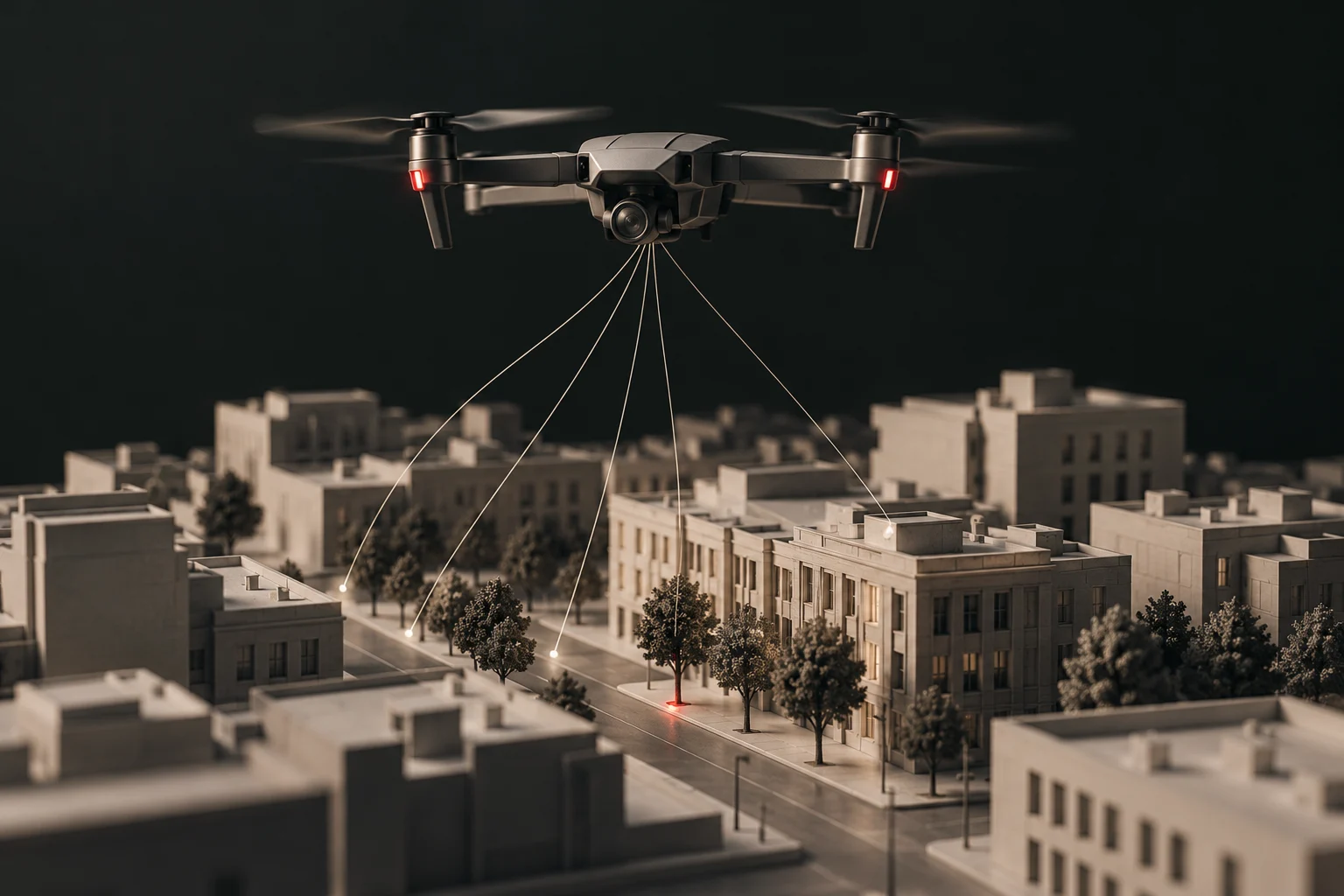
The FAA describes Remote ID as identification and location information transmitted by a drone in flight for reception by other parties. Its industry guidance describes the same broadcast purpose. FAA: Remote ID broadcasts and manufacturer compliance declarations
Standard Remote ID includes the control station location
Part 89 lists the aircraft identifier, aircraft position, altitude and velocity, control-station position and altitude, time mark and emergency status for Standard Remote ID. The control-station location must correspond to the person manipulating the flight controls. eCFR: 14 CFR Part 89, operating conditions and broadcast elements
A broadcast module reports the takeoff location
The module message list includes its serial number, aircraft position, altitude and velocity, takeoff position and altitude, and a time mark. Takeoff location and current control-station location are distinct fields in these two systems. eCFR: 14 CFR Part 89, operating conditions and broadcast elements
A Session ID is not a promised current privacy switch
Although Part 89 includes a Session ID option for Standard Remote ID, the FAA's public overview describes operators choosing it as a future possibility. Do not assume a current aircraft provides that choice. FAA: Remote ID types, registration and future Session ID wording · eCFR: 14 CFR Part 89, operating conditions and broadcast elements
Registration scope matters
The FAA says drones required to be registered, or already registered, must comply with Remote ID rules, including recreational, business and public-safety use. Its registration guidance links the relevant aircraft or module serial number to the device inventory. FAA: Remote ID types, registration and future Session ID wording
Questions and answers
Does a broadcast module report the same pilot-location field as Standard Remote ID?
The module list uses takeoff location; Standard Remote ID uses control-station location. eCFR: 14 CFR Part 89, operating conditions and broadcast elements
Can Remote ID be received by people other than the pilot?
The FAA describes reception by other parties. FAA: Remote ID broadcasts and manufacturer compliance declarations
Does the FAA present a Session ID choice as universally available now?
Its overview still describes a future possibility. FAA: Remote ID types, registration and future Session ID wording
Sources and scope
FAA guidance and 14 CFR Part 89 checked 10-24-2026. The eCFR view displayed Title 14 as current through October 22, 2026; that title-wide date is not a new amendment date for every Remote ID provision. FAA overview dated March 19, 2025; its Session ID wording remains prospective. This guide describes broadcast fields, without receiving flights, identifying pilots or measuring radio range.
- eCFR: 14 CFR Part 89, operating conditions and broadcast elements. Checked 10-24-2026.
- FAA: Remote ID broadcasts and manufacturer compliance declarations. Checked 10-24-2026.
- FAA: Remote ID types, registration and future Session ID wording. Checked 10-24-2026.