



Agency records · KY
Calloway County Sheriff's Office
License plate reader records for Calloway County. Each fact keeps its source and checked date.
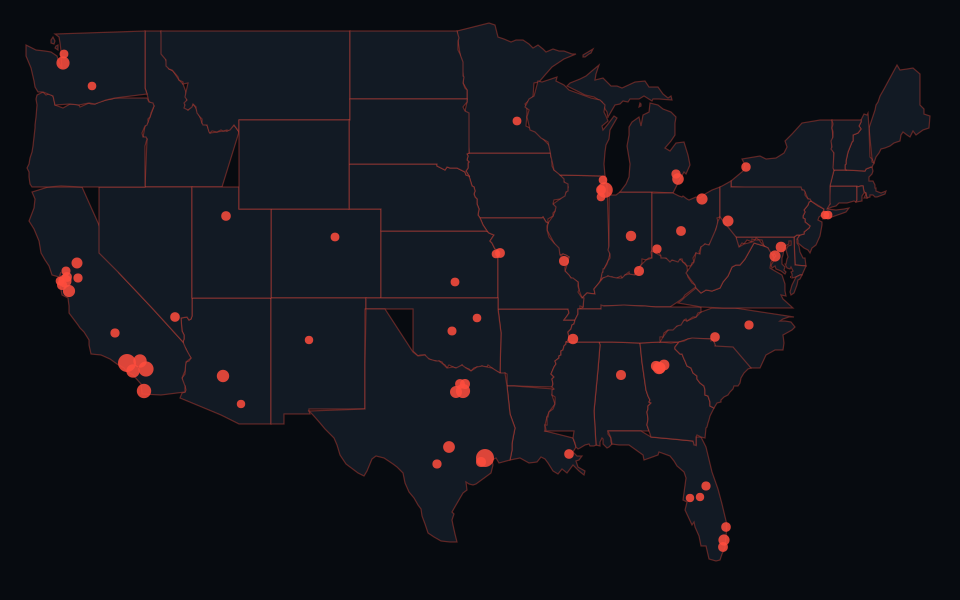
Written rules describe policy, not proof that every search follows it. Agency-reported camera totals have a different scope from community-mapped county points.
Program status reported by the source
The portal describes the Calloway County Sheriff's Office using Flock Safety for searches after incidents and hotlist alerts. This is the portal description, not independent verification of current operation or particular searches and outcomes.
Source. Checked 2026-10-24.
What the public record establishes
The portal embeds Guideline 79, marked implemented July 1, 2026, with its review date blank. That implementation date is distinct from the portal update of October 23, 2026 and this review on October 24. Source publication and later policy revisions were not established. Written requirements do not demonstrate actual settings, deletion or completed audits.
Source. Checked 2026-10-24.
Written camera policy
Only trained, authorized personnel may operate equipment or access ALPR data. Before action, officers must match the observed plate to the captured plate and validate the alert through a mobile terminal or dispatch. The wanted-status confirmation requirement allows an exigent-circumstances exception; the separate visual plate, issuing-state and vehicle-descriptor checks remain. A stop requires reasonable suspicion and a reasonable effort to confirm a wanted person is present or another lawful basis exists. These are written instructions, not observations of enforcement practice.
Source section Embedded Guideline 79, Procedures A and H-I. Checked 2026-10-24; source date 2026-07-01.
Plate reader vendors
Flock Safety
Program name on the portal; an executed supplier agreement and equipment model were not reviewed.
Source. Checked 2026-10-24.
Reported camera count
4 LPRs. Portal-listed LPR count. The separate combined total is also four, not four additional devices. This is not a physical inventory, current-operation check or a set of camera coordinates.
Source section Community Impact, LPR Cameras. Checked 2026-10-24; source date 2026-10-23.
Data retention
Guideline 79 sets a maximum of 90 days for ALPR data. Data kept for law enforcement purposes must be stored under policy and destroyed only according to the records retention schedule. This preservation condition is retained; the policy maximum is not substituted for the portal summary of 30 days or proof of actual deletion.
Source section Embedded Guideline 79, N.4. Checked 2026-10-24; source date 2026-07-01.
Retention displayed in the public portal
The summary displays 30 days. This is a portal display, separate from the embedded policy maximum and preservation rule. Current settings, local exports and actual deletion were not verified.
Source section Community Impact, Data Retention. Checked 2026-10-24; source date 2026-10-23.
Access and oversight
The guideline requires individual logins, approved training before access, official legitimate uses and documentation of a case number or incident number and/or inquiry reason. A reason must be entered before browsing detections. The sheriff or designee must ensure an audit every 90 days, randomly checking at least 10 inquiries from the preceding period. An internal memorandum must include data errors, receive sheriff or designee review and be filed with supporting records. Completed training, actual logs, audit results and resulting corrections were not reviewed.
Source section Embedded Guideline 79, Procedures A-D and P-Q. Checked 2026-10-24; source date 2026-07-01.
Access statement in the public portal
The separate portal cards require a valid reason and human verification before acting on hotlist hits. They prohibit immigration enforcement, harassment or intimidation, personal use and use based only on a protected class. The displayed prohibited-use card does not list traffic enforcement. Its indefinite-storage sentence leaves the record category unclear and is not adopted as a plate-data retention period.
Source section Policy and Trust, separate portal cards. Checked 2026-10-24; source date 2026-10-23.
Sharing rules
The guideline allows release to authorized, verified law enforcement officials and agencies for legitimate law enforcement purposes. It directs non-law-enforcement access requests to the process under KRS 189.632(4)(d), and written requests must go to the records custodian. Its retention section also limits sale, sharing, access and transfer to that statutory authorization. This summarizes the source policy, not a legal ruling or verification of particular recipients or completed releases.
Source section Embedded Guideline 79, N.4 and O. Checked 2026-10-24; source date 2026-07-01.
Details not yet verified
Named sharing partners, Contract value, Contract start date, Contract end date. No value is inferred from a county map count or another agency's policy.
Source documents
- Official Calloway County department directory identifying the Sheriff's Office. Checked 2026-10-24; source publication date not stated.
- Calloway County KY SO portal and embedded ALPR Guideline 79. Checked 2026-10-24; source publication date not stated.
- Census 2024 Vintage Calloway County identity. Checked 2026-10-24; source publication date not stated.
Local map
Calloway County camera guide. The county map includes source points from multiple operators. It is not this agency's inventory.
Understand the policy
Who can search Flock data? · How retention rules differ
How to read a camera policy · Why map counts differ from agency totals · All agency records · Tracking news